
What does OSHA actually require for handwashing on a job site?
Two different rules cover two different situations, and contractors mix them up constantly. General sanitation, meaning enough toilets for the crew, falls under OSHA 1926.51(c): one facility for 20 workers or fewer, then a toilet and urinal per 40 workers up to 200, then per 50 above that. That rule is about toilet count. It does not by itself require a sink. Washing facilities become mandatory under 1926.51(f)(1) specifically when employees apply paints, coatings, herbicides or insecticides, or handle other contaminants where residue could reach skin or mouth. If your Waterloo crew is doing demo and framing with no chemical exposure, you are covered by 1926.51(c) alone. Add a paint crew or a sprayer and you need a station with soap and towels, per 29 CFR 1910.141(d)(2), sitting near the work. Waterloo Porta Pros pairs handwashing station rental with standard porta potty rental on most job sites so both boxes get checked without a second delivery trip. Farms have their own rule: OSHA 1928.110 requires potable water, toilets and handwashing for hand-labor employees, one facility per 20 workers, within a quarter mile walk. That distance matters more on row crop ground outside Waterloo than it does on a tight urban lot.
How many handwashing stations does my Waterloo site need?
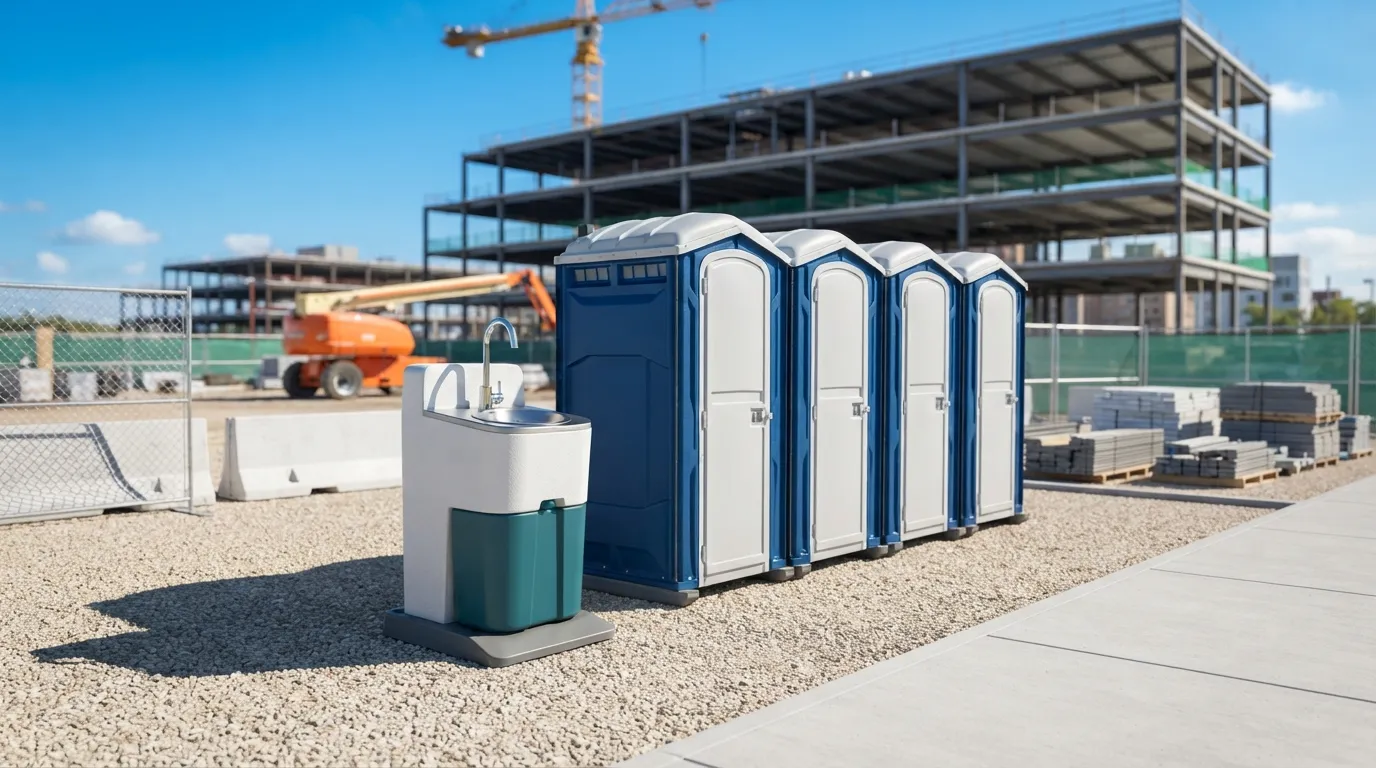
Match stations to your toilet count, not to a guess. If your crew needs three toilets under 1926.51(c), plan for a wash station at that same cluster, and add a second if the site spans more than one active work zone. A portable sink rental with a 60 to 70 gallon tank, the same holding capacity used on a standard toilet unit, handles a crew of 15 to 20 for a normal week between service visits. ANSI/PSAI Z4.3 sets that baseline service interval at once per week for up to 10 users over a 40 hour week, so a busier Waterloo crew may need twice-weekly refills rather than a bigger tank. Event organizers in Waterloo often underestimate this: a wedding or festival crowd of 150 needs stations spread across the grounds, not one bank by the gate. Pair units from event restroom rental or festival restroom rental with handwashing at the same footprint, and check hand sanitizer station rental only as a supplement, since sanitizer alone does not satisfy 29 CFR 1910.141(d)(2).
Where should handwashing stations go on a Waterloo site?
Placement rules echo ADA guidance even on sites with no ADA obligation, because they describe what actually works for people. ADA Standards section 403.5.1 calls for a 36 inch clear route to any fixture, and section 405.2 caps ramp slope at 1:12 if the ground isn't flat. Keep the approach on a stable, slip-resistant surface, consistent with ADA Standards section 302.1, especially with Waterloo winters turning gravel pads to mud or ice. Stations belong near the toilets, near the break area, and never blocking the path a forklift or delivery truck needs. A roll-off delivery alone needs about 60 feet of straight clearance behind the truck, so if your dumpster and your wash station share a laydown yard, plan the layout before either one shows up. See porta potty placement guide for the full logic, and porta potty in winter for freeze-proofing tips that apply to sinks as much as toilets. If a station clusters with single-user toilets, ADA Standards section 213.2 requires at least 5 percent of the cluster, and never fewer than one, to be accessible, which usually means pairing an ADA accessible porta potty with a lower-reach sink unit.
Do I need handwashing for an event or just for construction?
Both, and the standard doesn't loosen for a party tent. A wedding at a Waterloo venue, a county fair booth, or a golf tournament gallery all draw food, drink, and bare hands, and guests notice a missing sink faster than a missing sign. Pair wedding restroom rental or county fair restrooms with a wash station at the same tent line, not fifty feet off in a back corner. For food service at any Waterloo event, grease matters too: a grease interceptor gets pumped once fats, oils, grease and solids hit 25 percent of liquid depth, which is a good reminder to check grease trap pumping if you're running a food trailer. Farther out, Cedar Falls sits 6.7 miles west and Evansdale 6.4 miles southeast, both inside the same one-day delivery radius Waterloo Porta Pros runs for weekend events, so a Saturday booking rarely needs more than a phone call by Thursday.
Does hand sanitizer count as handwashing under OSHA?
No. 29 CFR 1910.141(d)(2) specifically requires soap and towels or a hand-drying device. Sanitizer can supplement a station between services, but it can't replace the sink. Waterloo Porta Pros treats hand sanitizer station rental as an add-on, never a substitute, on any job or event site.
Do I need a permit for a handwashing station in Waterloo?
Placement in the public right of way needs confirming with the city before delivery. Waterloo Porta Pros checks this on request, but permit rules vary by site and by whether the unit sits on a sidewalk, street or private lot. Ask early. See porta potty permit requirements for the general framework.
How often does a handwashing station get serviced?
ANSI/PSAI Z4.3 sets a weekly baseline for up to 10 users over a 40 hour week. Busy Waterloo job sites or multi-day events usually need twice-weekly refills. Check how often are porta potties cleaned for the service cadence Waterloo Porta Pros runs on paired units.
Can I rent just a handwashing station without a porta potty?
Yes. Farms, food booths and small crews sometimes need only a sink. Request one through portable sink rental or request a quote, and Waterloo Porta Pros will size the tank to your headcount rather than bundling it with a toilet you don't need.
What's the difference between a handwashing station and a hand sanitizer stand?
A handwashing station has running water, soap and towels, meeting 29 CFR 1910.141(d)(2). A sanitizer stand is just gel or foam, no water. OSHA accepts sanitizer as a supplement only. See handwashing station rental for unit options.
Next step
Get a delivery date
Tell us the address, the dates and the headcount. We size the order and confirm the route.